
Making Good on a Bad Strategy
Nothing quite like spending weeks getting everyone aligned on priorities, only to find out they’ve changed again.
I remember leading a product team and having people ask me why we were changing direction on something we’d agreed was important just a few weeks earlier. Fair question.
Sometimes priorities shifted for good reasons. Other times, I’d push back, asking what had changed or what problem we were actually trying to solve. Some of those conversations were productive. Others didn’t get very far, particularly when the decision had already been made and people weren’t especially interested in revisiting it.
And so it went. Someone would escalate an issue, it would jump to the top of the list, and we’d rearrange everything to accommodate it. We’d spend a lot of time talking about deadlines, deliverables, and whether things were on track.
We could tell you whether something shipped on time. We couldn’t always tell you whether it had made a difference.
What bothered me most was the position I was putting my team in. I was encouraging them to ask questions, challenge assumptions, and understand problems before jumping into solutions. Then we’d commit to work with deadlines that barely gave them a chance to do any of it.
It’s pretty hard to convince people their thinking matters when the decisions around them suggest otherwise.
These were some of the frustrations Ira Cummings and I kept coming back to when we were putting together our talk, Make Good on a Bad Strategy, for the UXPA Boston 2026 Conference.
We called it a Bad Strategy Environment® (BSE). Not because the company has a terrible strategy, but because whatever strategy exists isn’t helping people make decisions about what matters most.
A quick detour on what strategy actually means
Ira and I kept coming back to a pretty simple way of thinking about strategy: it’s as much about what you say no to as what you say yes to.
And you have to say no to something. We don’t have unlimited time, money, or people. (And no, AI isn’t going to magically fix that. More on that another time.)
That’s why a long list of priorities isn’t a strategy. If it doesn’t help people make choices about what matters most, those choices end up being made some other way. Usually by whoever is making the most noise or whatever issue has just been escalated.
So what do you do when you’re working in an environment like this?
You can get frustrated, complain about leadership, or wait for someone to sort it out. I’ve done my share of that, too.
I couldn’t control every decision being made across the organization, but I could change how I approached them. Turns out, I had more room to influence things than I sometimes gave myself credit for. And so do you.
Here are three things I’ve found helpful.
1. Read the room
There’s often a difference between what an organization says matters and what its decisions tell you matters.
At the company I mentioned earlier, we had a vision centered on helping patients get access to care. It was something people genuinely believed in. But much of our work focused on operational efficiencies and technology improvements.
And that’s not necessarily a problem. Those things can absolutely contribute to a better patient experience.
What became clear over time was that operational efficiency was driving many of our decisions, even though we talked much more about improving patient care. Efficiency wasn’t the wrong goal, but we weren’t having meaningful conversations about the trade-offs we were making, or how the work connected back to that broader vision.
If you want to understand what really matters to an organization, pay attention to what happens when priorities collide. Which projects suddenly become untouchable? What gets dropped the minute something more urgent comes along? And whose opinion tends to carry the most weight?
Those patterns can tell you a lot about what’s driving decisions. They can also help you understand what leadership actually expects your team to accomplish, which isn’t always the same as what’s written in the strategy.
Something to try: If you’re struggling to understand a decision, I’d start by talking to the person who made it. Be genuinely curious about what’s driving their thinking. What are they being measured on? What pressures are coming from elsewhere in the business? This probably isn’t a surprise, but most people love to talk about the things that are important to them.
You may still disagree with the decision, but at least you’ll understand what you’re disagreeing with.
2. Follow the money
For a long time, I kept pushing for more discovery. I wanted us to understand the problem before we committed to building something, which seemed pretty reasonable to me.
But projects already had deadlines and expected $$ attached to them. Asking for more time wasn’t getting me anywhere. In an organization that already struggled to meet deadlines, “discovery” had started to sound like just another reason things would take longer.
So I tried a different approach.
Instead of asking for more discovery time, I started asking how confident we were that the proposed solution would actually deliver the savings we were counting on.
What assumptions were behind those expected results? How much time did the process take today? What work would the solution eliminate? What had we overlooked? Are we comfortable with moving forward without having all those answers?
We weren’t debating whether Product needed more time. We were discussing the risk of spending money on something that might not achieve its goal.
Of course, not every business is optimizing for operational efficiency. Some compete on price, others on experience, convenience, specialization, or access to new markets. The point is to understand what matters to your business and why. Otherwise, you can spend an awful lot of time making perfectly reasonable arguments that nobody is interested in hearing.
Something to try: Talk to someone in finance, operations, or another part of the business you don’t normally work with. Ask how the business makes money, what drives costs, and what leadership is trying to improve. Then look at your team’s priorities through that lens.
Can you explain how the work contributes to those outcomes? If you can’t, that’s worth exploring before committing more time and money to it.
3. Make a bet
At one point, our roadmap was filling up with requests for patient text messaging. Appointment reminders, outreach campaigns, all sorts of things we could potentially automate. There was a push to modernize how we communicated with patients while reducing the time our teams spent making phone calls. Fair enough.
But one of our product managers asked a great question: Were we looking at this too narrowly?
We knew patients weren’t always responding to our outreach, and getting them scheduled for care involved a lot of manual work. What we didn’t really understand was what patients were experiencing across all those interactions.
SMS might help, but we suspected there was more going on.
I made the case for spending one sprint mapping the patient journey. Not to redesign everything or launch some enormous research initiative. Just enough time to understand what was happening before we committed to building more.
And we found friction everywhere.
Patients were being contacted by different teams, sometimes without understanding who we were or why we were calling. There were repeated interactions, confusing handoffs, and plenty of opportunities for people to drop out of the process.
Suddenly, we had a different way to think about the work. Instead of treating every SMS request as a separate project, we could see where communication was breaking down and where improving the patient experience might also reduce our costs.
We shared what we’d learned with leadership, and it changed the conversation. Instead of debating which SMS features to build, we were talking about where patients were getting stuck and what we could do to improve their experience.
We still explored SMS, but now we had a better understanding of the problems we were trying to solve and could make more informed decisions about what was worth building.
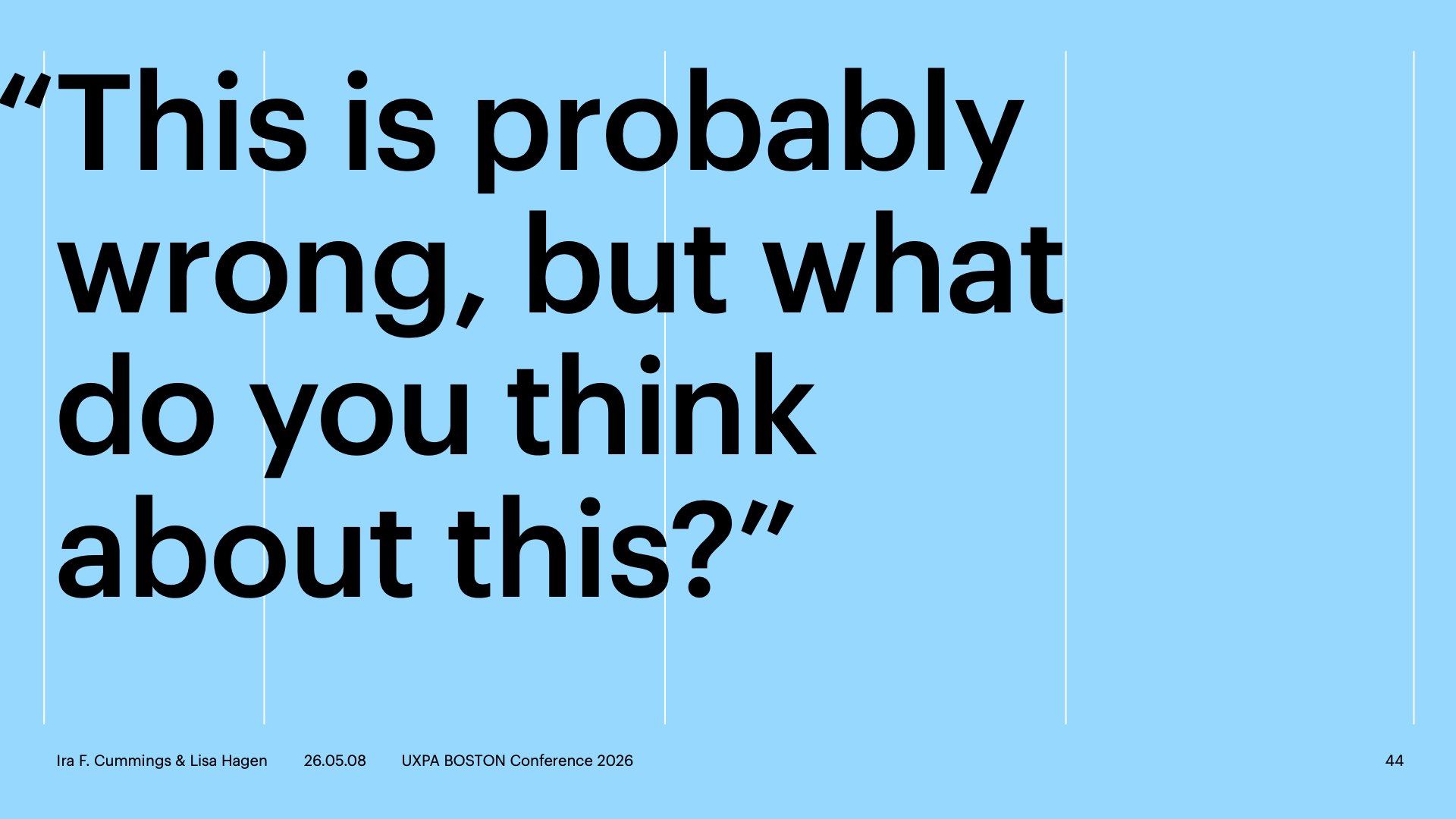
Something to try: If you think your team is approaching a problem the wrong way, put forward an alternative. Talk it through with someone you trust. You can start with, “This is probably wrong, but what do you think?”
Then see if you can make a case for a small investment in testing your thinking. You’re not asking everyone to abandon the plan, just to find out whether there’s a better way to approach the problem.
You don’t have to fix the strategy
I’m not suggesting any of this will fix a company that doesn’t want to change. I’ve worked with leaders who welcomed these conversations and others who really didn’t.
But something Ira and I talked about is that you don’t need to be the person setting the company’s strategy to have a hand in shaping it.
You can ask why something matters. You can challenge an assumption, suggest a different approach, or help people understand the trade-offs they’re making.
Will it always work? Of course not. Sometimes you’ll get nowhere. But I’ve found that even small changes in how you approach these conversations can make a difference.
And I’d much rather try to influence a decision than spend another six months delivering something nobody can explain the value of.
Sound familiar? What’s worked for you? Join the conversation on Substack.
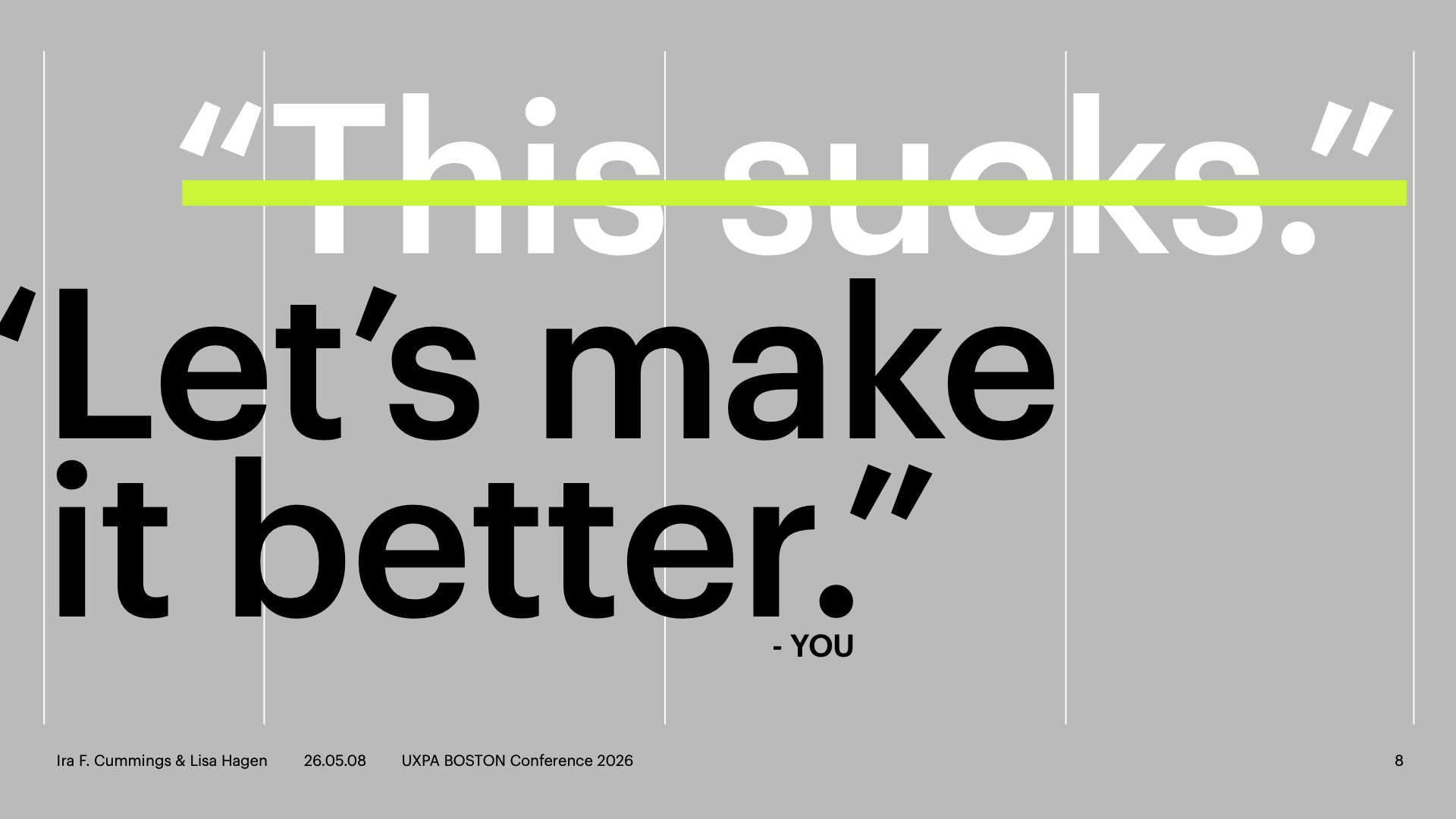
Based on Make Good on a Bad Strategy, a talk developed and presented with Ira F. Cummings at UXPA Boston 2026.
This article was originally published on The Roadmap to Nowhere, our Substack.